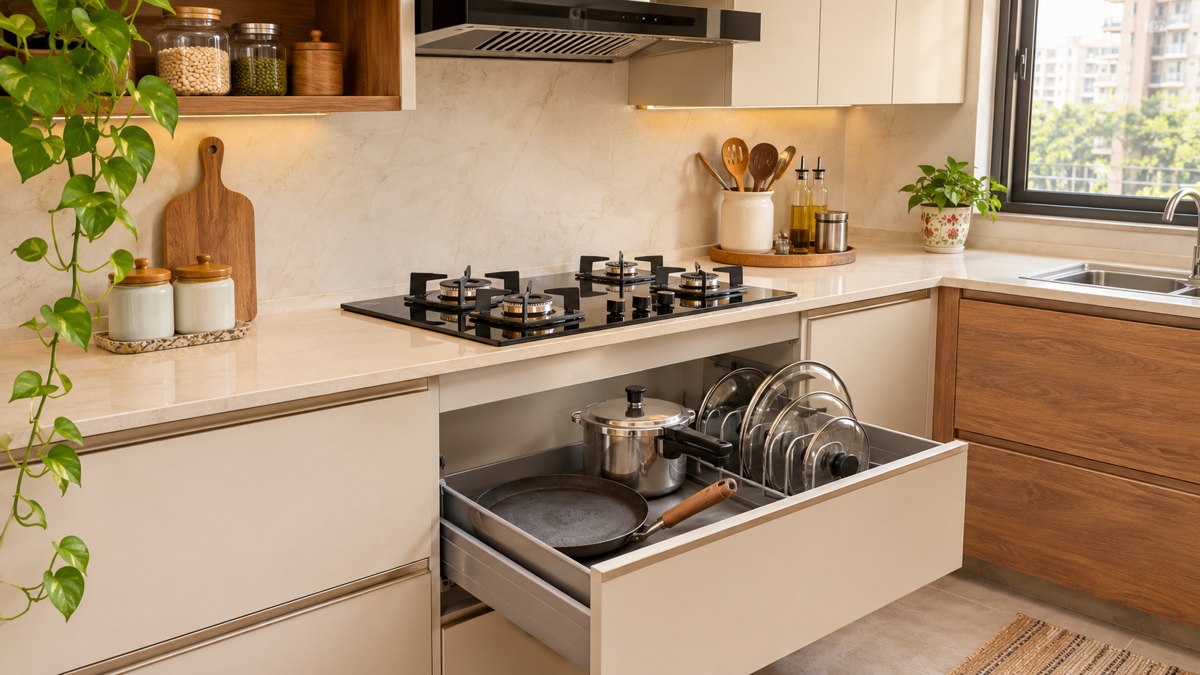
Drawers below the hob work well for everyday pans when the hob installation leaves enough usable space and you can open a drawer comfortably while cooking. A drawer cabinet beside the hob is often easier to share: one person can take out a kadai or put away a pressure cooker while the other stays at the stove.
Before choosing, test the layout with three things from your own kitchen: your widest tawa, your tallest pressure cooker and the lid you reach for most often. They reveal more about the drawer sizes you need than a standard “three-drawer unit” on a quotation.
Compare two layouts for the same kitchen
Picture an L-shaped kitchen with the hob on the longer counter and a prep area immediately to its right. Keep the hob, sink and countertop in the same positions. The only decision is where the cookware goes.
| What happens during cooking? | Layout 1 · Drawers below the hob | Layout 2 · Drawer cabinet beside the hob |
|---|---|---|
| You need a second pan. | Step back, open the drawer and lift the pan up to the counter. | Step to the side and lift the pan onto the prep counter. |
| Someone else is cooking. | The person at the stove may need to move for the drawer to open. | A second person can reach the cookware if the prep area and aisle are clear. |
| You need the tallest drawer. | The hob body and its installation requirements affect the space available below the counter. | The cabinet can be planned around your tallest vessel, subject to its own dimensions and fittings. |
| You want lids close at hand. | A divider in the cookware drawer can keep lids beside their pans. | A narrow section at the hob end of the adjacent drawer can keep frequently used lids within reach. |
If you usually cook alone, moving one step to the side may make little difference. If two people make breakfast together, try a more revealing test: one person stands at the hob making dosas while the other takes out the pressure cooker. Which drawer can the second person open without asking the first to move?
What fits in a kitchen drawer? Measure these three utensils
1. Measure the tawa with its handle
A tawa with a 30 cm cooking surface might measure 48 cm from the far edge to the handle tip. Suppose the drawer has 45 cm of usable internal depth. The tawa will not lie straight from front to back. It might fit sideways in a wider drawer, but then the handle occupies space you may have intended for a saucepan.
Trace the tawa on paper and place that outline inside the proposed drawer dimensions. Add your second most-used pan. If you can lift either one without removing the other, the arrangement works for daily cooking.
2. Measure the pressure cooker the way you put it away
If you store the cooker with its lid on, measure from the base to the highest point in that position. If the lid lives separately, measure both pieces and give the lid a place in the drawing. Check the clear height from the drawer base to the first obstruction above it. A tall drawer front can conceal a shallower usable space.
For a drawer below the hob, give the kitchen vendor the exact hob model. Ask them to show its installation requirements and the resulting usable drawer height on the same section drawing. That lets you choose the drawer contents before the cabinet is made.
3. Give lids their own reachable space
A lid stored under two nested kadais means unloading the stack midway through cooking. Try a vertical divider along one side of a deep drawer, or reserve a shallow drawer for lids if your layout allows it. Measure the largest lid with its knob or handle before deciding the divider spacing.
When does a separate utensil cabinet earn its place?
A separate cabinet is worth considering if you own several bulky vessels or regularly cook with another person. Put everyday cookware in the part nearest the hob. Give the large biryani pot, idli steamer or extra pressure cooker a lower shelf if you use it less often.
There is a useful middle option, too. Keep daily tawas and frying pans in a drawer beside the hob, and put occasional-use vessels in a separate cabinet. This lets you size the prime cooking drawer around what you use every morning, even if your largest pot comes out only when guests visit.
What should the kitchen quote specify?
Ask for the usable internal width, depth and height of each proposed drawer, its extension, the runner brand and model, and the rated load for the selected system. If you intend to store cast-iron cookware or several steel vessels together, give the vendor their combined weight and ask them to confirm suitability. Also ask whether lid dividers and organisers are included in the price.
Frequently asked questions
Is a deep drawer better than a shelf for heavy utensils?
A drawer brings the vessel forward, which can make it easier to grip. A front shelf can work equally well for one large pot you can reach directly. Compare the actual lifting movement, the weight of everything stored together and the cost of the fittings.
Can a three-drawer unit go directly below any hob?
The answer depends on the selected hob, cabinet and installation instructions. Ask for a section drawing showing the hob body, required clearances, service access and finished drawer positions before approving the unit.
How do I choose between the two layouts before installation?
Mark the drawer fronts on the floor with tape. Place a carton where each open drawer would extend. Have one person stand at the hob while another retrieves a pan from the proposed position. A two-minute test can reveal whether the issue is drawer capacity or simply where someone has to stand.
Plan your next steps with Houspire
Explore Houspire for design support before ordering cabinetry. Share your measured plan, appliance models and container or utensil dimensions. Confirm the package deliverables, then have your execution team verify site measurements, hardware suitability and installation details.
Read more about kitchen layout planning and kitchen planning mistakes to avoid.