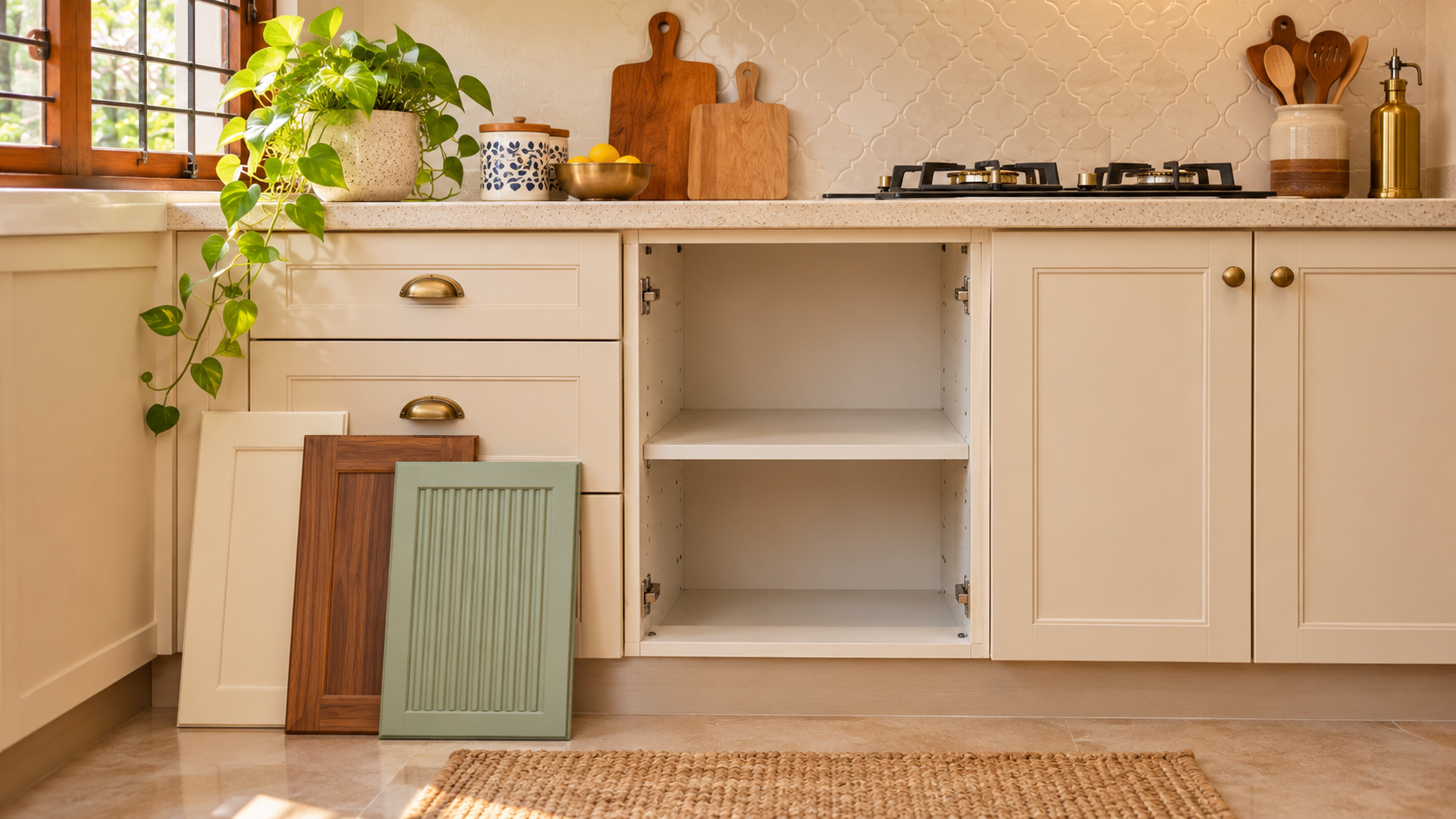
Replace only the shutters when the cabinet boxes are sound and the layout works. Consider partial replacement when damage is confined to a few units, or a full rebuild when damage is widespread or the layout needs to change. Start by inspecting the boxes, especially beneath the sink.
Understand What You Are Replacing
A kitchen cabinet has several components that can be assessed separately.
| Component | What it means |
|---|---|
| Cabinet box or carcass | The main structure, including sides, base, top or rails, and back |
| Shutters | The doors attached to the cabinet |
| Drawer fronts | The visible panels on the front of drawers |
| Drawer boxes and runners | The storage compartments and mechanisms behind the fronts |
| Hardware | Hinges, handles, runners and other fittings |
| Exposed panels and plinths | Visible cabinet sides, fillers and finishing pieces near the floor |
| Countertop | The work surface above the base cabinets |
Replacing shutters does not automatically include drawer boxes, exposed panels, hinges or the countertop. Ask the vendor to name each component included in the work.
Compare the Three Renovation Scopes
| Question | Refresh | Partial replacement | Full rebuild |
|---|---|---|---|
| What stays? | Sound cabinet boxes and existing layout | Usable cabinets and selected existing elements | Only items specifically approved for reuse |
| What changes? | Shutters, drawer fronts, selected hardware and visible finishes | Identified cabinets, plus agreed fronts or fittings | All cabinet boxes, fronts and associated fittings |
| Main purpose | Update appearance and address minor functional issues | Resolve local damage or improve specific storage | Replace deteriorated cabinetry or substantially redesign storage |
| Layout changes | Usually minimal | Limited to affected areas | Can accommodate a revised layout |
| Main uncertainty | Compatibility with existing cabinets | Connections between retained and new work | Removal, site preparation and service changes |
| Quotation priority | Exact front, hardware and finish schedule | Unit-by-unit retention and replacement list | Complete cabinet and related-work schedule |
A full cabinet rebuild does not necessarily mean moving plumbing, replacing flooring or buying new appliances. Those are separate decisions that should be priced explicitly.
Option 1: Refresh the Kitchen and Replace the Shutters
A refresh suits a kitchen whose main structure and arrangement still work.
It may include new shutters and drawer fronts, replacement handles, selected hinges, drawer adjustments and matching finishes on exposed sides.
Home Depot’s refacing guidance similarly identifies sound cabinet structures and a satisfactory existing layout as key conditions for retaining the cabinets. The Home Depot
When a Refresh Makes Sense
Consider it when:
- Cabinet boxes are firm, dry and securely installed.
- Shelves and internal storage remain usable.
- The sink, hob and appliance positions work for your routine.
- The main problem is the appearance or condition of the fronts.
- Replacement hardware can be fitted securely. Have the carpenter inspect hinge fixing points and cabinet alignment. A loose door may need an adjustment, but it may also indicate damage where the hinge attaches.
What the Quote Should Include
Request separate quantities for shutters, drawer fronts, exposed panels, plinths, handles and hinges.
Also confirm removal, disposal, drilling, installation and final alignment. A quote for “new laminate shutters” may leave the old visible cabinet sides unchanged.
Do not assume replacement fronts are interchangeable. Dimensions, hinge positions, overlays and system compatibility matter. IKEA, for example, states that its current door models are incompatible with its older AKURUM cabinet range. That is a specific product example, but it illustrates why the existing system must be identified before ordering. IKEA United States
Option 2: Replace Only the Cabinets That Need Work
Partial replacement suits a kitchen where the problems are confined to identifiable units.
For example, the sink base may need replacement while the wall cabinets and other base cabinets remain usable. Alternatively, one poorly organised cupboard might be replaced with a drawer unit.
When Partial Replacement Makes Sense
Consider it when:
- Damage is limited and the remaining cabinets pass inspection.
- Most of the layout works.
- A few units account for the storage problems.
- New units can connect properly with the retained cabinets.
- The countertop can be retained or its replacement cost is understood. Where moisture damage exists, identify and resolve its source before installing replacement cabinetry.
The Main Challenge: Joining Old and New Work
The new cabinets must align with existing heights, depths, fronts and countertop supports.
Matching an older laminate can also be difficult. Even the same product code may look different beside a finish that has aged.
Ask for physical samples. You may prefer an intentional two-colour scheme or replacement of all visible fronts rather than an approximate match.
Check the Countertop Before Removing Base Cabinets
Do not assume the countertop can remain untouched while cabinets beneath it are removed.
Have the installer assess its support, joints, sink cutout and removal access. The quote should state whether temporary support, lifting, reinstatement or replacement is required—and who is responsible for the work.
Option 3: Rebuild the Kitchen Cabinets
A full rebuild replaces the cabinet system and gives you the opportunity to reconsider the storage arrangement.
It deserves consideration when several cabinet boxes are deteriorated, substantial repairs are needed throughout, or the current configuration cannot accommodate your requirements.
When a Full Rebuild Makes Sense
Examples include:
- Widespread damage to cabinet structures.
- Multiple units that cannot securely support their doors or fittings.
- A layout that requires significant cabinet changes.
- New appliance requirements that conflict with existing units.
- A partial-repair proposal that leaves too much compromised cabinetry in place. Cabinet age alone should not decide the scope. Assess condition, usefulness and repair feasibility.
What a Full Rebuild Quote Should Include
Beyond new cabinets, check allowances for:
- Dismantling and debris removal.
- Protection of retained flooring and appliances.
- Wall repairs and surface preparation.
- Countertop work.
- Sink and appliance disconnection and reconnection.
- Any agreed plumbing or electrical changes.
- Delivery, carrying and installation.
- Final adjustments and cleaning. Identify reusable items by model and condition. A working appliance may still be suitable for the new layout, subject to its installation requirements.
Compare All Three Options for the Same Kitchen
Imagine an existing kitchen with dated shutters, one damaged sink base and otherwise usable cabinets.
The following comparison shows possible scopes—not a diagnosis or a priced case study.
| Work item | Refresh | Partial replacement | Full rebuild |
|---|---|---|---|
| Replace dated shutters | Included | Included if required for a consistent finish | Included |
| Address damaged sink base | Refresh is unsuitable if the box is unsound | Replace the affected unit | Replace with all other boxes |
| Retain sound wall cabinets | Yes | Yes | No, if all cabinetry is being rebuilt |
| Improve one storage unit | Limited by existing structure | Replace or modify the selected unit | Incorporate into the new design |
| Retain countertop | Subject to inspection | Subject to replacement access and support | Subject to condition and new layout |
| Change appliance positions | Outside the basic scope | Assess individually | Can be designed and priced separately |
In this example, a shutter-only quote would not resolve the damaged sink base. Partial replacement may be worth investigating before committing to an entirely new cabinet system.
The inspection could change that conclusion if concealed damage is discovered.
How Should You Compare Costs?
Request three itemised proposals from the same inspection findings.
Refresh total: fronts, selected hardware, exposed finishes, removal and fitting.
Partial replacement total: selected new cabinet boxes, associated fronts and hardware, work connecting old and new units, and any countertop or service work.
Full rebuild total: complete cabinetry, removal, preparation, countertop decisions, service work and installation.
Use the same finish and hardware specification wherever the scopes overlap. Otherwise, a premium refresh can be compared unfairly with a basic rebuild.
Ask each vendor to state:
- What is retained and excluded.
- Which quantities have been measured.
- Which costs remain provisional.
- What could change after dismantling.
- How additional work will be approved.
- Whether taxes, delivery and disposal are included. Avoid relying on a universal saving percentage. The condition of your kitchen and the work needed around retained elements determine the actual difference.
Compare Disruption and After-Sales Support
Ask for both the total project duration and the period when the kitchen will be unusable.
A refresh may leave the countertop and sink functioning during part of the work. Partial replacement around the sink can interrupt use despite involving fewer cabinets. A full rebuild requires coordination across more activities.
Confirm who supports the finished result. With a refresh, the supplier may cover new shutters and installation without accepting responsibility for old cabinet boxes. With partial replacement, record which retained and new components fall within the contractor’s scope.
Photograph the kitchen before work and keep the approved retention list with the quotation.
Related guides
Frequently asked questions
Can I replace kitchen shutters without replacing the cabinets?
Yes, if the cabinet boxes are sound and suitable replacement shutters can be fitted. Check dimensions, hinge compatibility, fixing points and alignment before ordering.
Will new shutters fix sagging cabinet doors?
They may help if the shutter itself is damaged. Sagging can also result from loose hinges, weakened fixing points or cabinet misalignment. Identify the cause first.
Can I replace only the sink cabinet?
Potentially. The installer must assess surrounding cabinets, plumbing and countertop support. Resolve any leak or moisture source before installing the replacement.
Should I keep the existing countertop?
Keep it if its condition, dimensions and compatibility suit the proposed work. Confirm whether it can be protected and supported during cabinet removal.
Is a refresh always cheaper than a full rebuild?
It involves fewer replacement components, but the final price depends on finishes, hardware, repairs and fitting work. Compare complete quotations rather than assuming a fixed saving.
Can online design determine whether my cabinets need replacement?
Photos can help identify visible concerns and plan design options. They cannot establish the condition of concealed panels, joints and fixings. Have an execution professional inspect the kitchen before finalising the renovation scope.
Plan your next steps with Houspire
Decide which cabinet boxes can stay before paying for new fronts or asking vendors to price a full rebuild. Explore Houspire’s design plans to see what the design stage can help you decide.