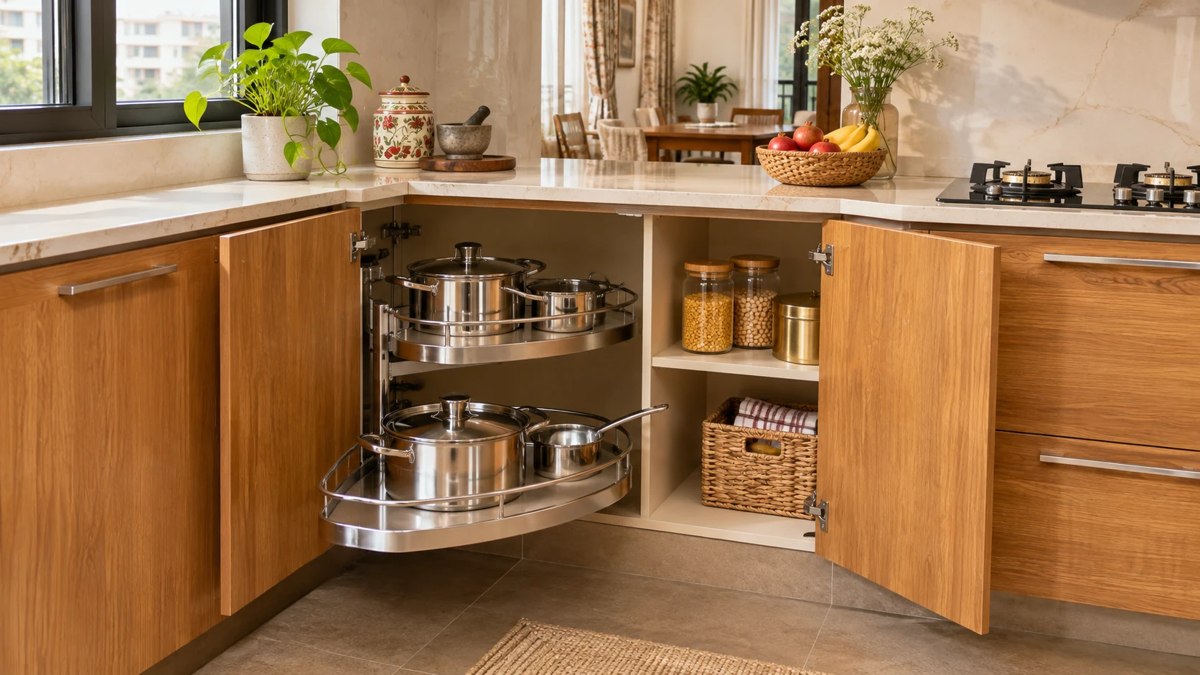
L-shaped kitchen corner storage works best when you can retrieve the cookware you actually use. Compare fixed shelves, rotating trays, pull-outs and adjoining drawers by their usable dimensions, access and complete cost.
Start with your largest pot, not the hardware catalogue.
Which corner storage option suits your kitchen?
| Option | When it earns its space | What to check before ordering |
|---|---|---|
| Fixed corner shelves | You store bulky items that come out occasionally and want to keep the cabinet cost down. | Can your largest pot pass through the door? Can you reach the back shelf and lift it out? |
| Rotating carousel | You want to turn the shelf and bring several smaller items towards the opening. | Do your pots, lids and projecting handles stay within the tray as it rotates? |
| Corner pull-out | You use the cookware regularly and want the trays to move towards you. | Check the exact model’s usable tray dimensions, load rating, opening requirement and movement outside the cabinet. |
| Wide drawers beside a closed corner | Most of your cooking happens near the hob, and you prefer opening one drawer to retrieve a pan. | Ask how much drawer width the layout gives you and whether the drawer nearest the corner opens past adjoining handles. |
Start with the utensil that is hardest to store
Take your widest kadai and measure it from handle to handle. Suppose its body is 32 cm wide but its handles bring the overall width to 41 cm. If a pull-out tray has 38 cm of clear space between its rails, the kadai cannot sit flat across that width. It might fit at an angle, but that could use the space you expected to give a second pot. Take the kadai to the showroom or cut a cardboard outline with both handles included.
Now try the same test with a fixed shelf. The shelf itself may be wide enough, yet the cabinet opening could force you to tilt the kadai to get it inside. Try taking it back out with another pot at the front. Retrieving one vessel is a better test than seeing how many fit in an empty cabinet.
What should you check on an L-shaped kitchen drawing?
Start with the two cabinet runs where they meet. One may contain a blind corner, where part of the storage extends sideways behind the adjoining run. Ask the designer to mark the actual door opening and show the chosen shelf or mechanism in its fully open position.
Three details can change the decision:
- The neighbouring drawer. If your everyday cutlery drawer sits immediately around the corner, see whether its handle obstructs the corner shutter. Then check whether you can reach the drawer while the corner tray is out.
- The place where you stand. A tray that extends into the aisle needs room for both the mechanism and the person using it. Mark its open position on the floor and stand where you would lift out a heavy vessel.
- The route to the hob. Trace how you would take out a pan, set it down and return the lid. If a wide drawer beside the hob makes that sequence easier, price that layout before investing in corner hardware.
How do you compare the quotes fairly?
Ask the vendor to price the same corner three ways: fixed shelves, the selected pull-out and a closed corner with adjoining drawers. The third option changes the neighbouring cabinet, so compare the total price for the corner and that cabinet together.
For the pull-out, ask for the brand, model, number of trays, usable dimensions, load rating and installation charge. For fixed shelves, ask for the shelf count, clear opening and internal finish. For drawers, record the usable internal width, depth and runner specification. This gives you three answers to the same question: What will it cost to store and retrieve the cookware I use?
Frequently asked questions
Can I install a corner pull-out after the kitchen is finished?
Possibly, if a specific model fits the finished cabinet. If you hope to add one later, shortlist it now and have the vendor check its opening width, internal dimensions, fixing positions and door arrangement. Ask them to identify any shelf or partition that would need removal.
Where should I store a heavy pressure cooker?
Choose a position where you can grip it securely and lift it without twisting into the cabinet. An accessible lower drawer or front shelf is worth testing. If you plan to use a pull-out, include the cooker and the other items sharing its tray when checking the manufacturer’s load rating.
Is leaving a kitchen corner empty a waste of space?
It depends on what the adjoining drawers can hold. If closing the corner gives you a wide drawer for everyday pans and another for lids, count how many items now have an accessible home. Compare that with what you could comfortably retrieve from the corner shelf.
Plan your next steps with Houspire
Use Houspire to explore design support for your room before committing to purchases. Confirm the selected package’s views, drawings, revisions and exclusions; have your execution team verify site measurements and construction details.
For related guidance, read kitchen planning mistakes and kitchen pricing units.