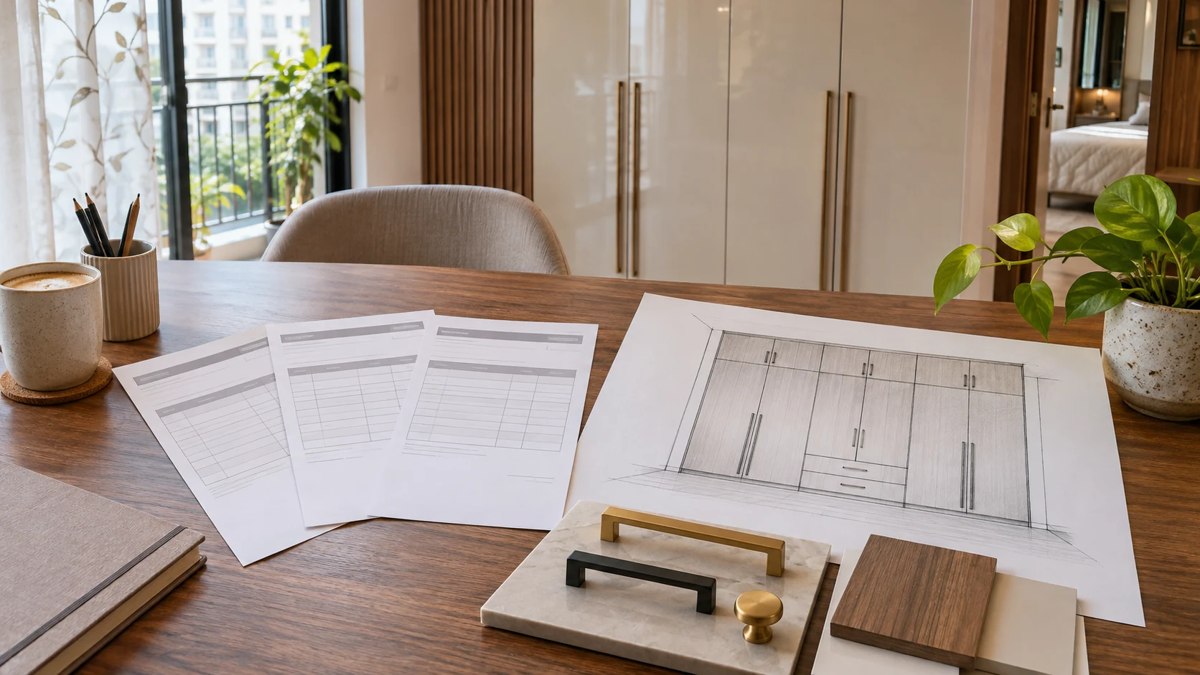
Different carpenter quotes for the same render often reflect different assumptions. Match dimensions, materials, internals, hardware and installation before comparing totals.
This guide uses a three-quote example to show how missing items can change the result.
Why Do Carpenters Quote Different Prices for the Same Design?
A finished wardrobe or TV unit can look similar while being built differently.
The image may show a wood finish, but it may not establish whether the cabinet uses plywood, MDF or another board. Closed shutters conceal shelves, drawers, partitions and hardware.
Vendors may also make different assumptions about delivery, installation and site preparation.
| What looks the same | What may differ in the quotation |
|---|---|
| Wardrobe exterior | Board specification, back panel and internal layout |
| Wood-look finish | Laminate, veneer or another finish |
| Handle-free drawers | Recessed pulls, profiles or push-to-open mechanisms |
| Closed shutters | Hinge models, quantities and opening arrangements |
| Full-height cabinetry | Whether the loft and ceiling fillers are included |
| Floating TV console | Mounting arrangement and wall preparation |
| Complete room render | Whether loose furniture, lighting and curtains are included |
A lower price may reflect a simpler specification, fewer inclusions or a more competitive supplier. A higher price may include additional work or services.
Price alone does not establish either quality or overcharging.
1. Give Every Carpenter the Same Information
Prepare one quotation brief and send the same version to every vendor.
Include:
- Dimensioned furniture layouts and relevant elevations.
- Internal arrangements for wardrobes and cabinets.
- Materials and finish selections.
- Hardware requirements.
- Quantities of each unit.
- Site photographs and access details.
- A list of inclusions and exclusions.
If some specifications are undecided, ask vendors to price the same base option and show alternatives separately.
For example: Quote the wardrobe with the specified laminate finish. Show the additional cost of the proposed acrylic alternative as a separate option.
This lets you compare the original requirement without losing useful suggestions.
Ask each carpenter to identify any departure from the brief. Substitutions should be visible before you compare totals.
2. Check Dimensions and Measurement Methods
A rate is meaningful only when you know what it measures.
If a wardrobe is priced by front elevation area, the calculation is:
Width × height = quoted elevation area
For an illustrative wardrobe measuring 6 feet wide and 7 feet high:
6 × 7 = 42 sq ft
That calculation does not establish the wardrobe depth or its internal fittings. Record those separately.
For each item, confirm:
| Measurement detail | What to establish |
|---|---|
| Width, height and depth | Whether dimensions are external or internal |
| Loft | Included in the main height or quoted separately |
| Side panels | Whether exposed ends attract an additional charge |
| Fillers | How gaps beside walls and ceilings are treated |
| Drawers and shelves | Included quantities and dimensions |
| Pricing unit | Per unit, square foot, running foot or another basis |
Do not compare a 7-foot-high wardrobe with a floor-to-ceiling unit simply because both are described as “6-foot wardrobes.”
Have the selected carpenter verify site measurements before fabrication. Any resulting scope or price change should be documented before work proceeds.
3. Replace “Good Quality Material” With a Written Specification
Descriptions such as “premium plywood” and “branded laminate” leave important details unanswered.
Ask for the manufacturer, product, grade and thickness wherever relevant.
| Component | Details to request |
|---|---|
| Cabinet body or carcass | Board manufacturer, product, grade and thickness |
| Back panel | Material, thickness and fixing method |
| Shutters | Substrate, thickness and finish |
| External laminate | Brand, product code, finish and thickness |
| Internal finish | Material, colour and thickness |
| Exposed edges | Specified edging or finishing treatment |
| Glass or mirror | Type, thickness, dimensions and fixing detail |
Record each component separately. A quotation that specifies the carcass board may still leave the shutter or back-panel construction unclear.
Avoid choosing a material solely because a salesperson calls it “best.” Ask why it suits the unit, its location and the proposed construction.
4. Match Hardware Models, Not Just Brands
Two quotations can name the same hardware brand and still supply different products.
For drawers and shutters, compare:
- Brand and model or product series.
- Quantity.
- Runner length and extension type.
- Soft-close or push-to-open function.
- Rated capacity where relevant.
- Compatibility with the proposed furniture.
Ask the carpenter to explain how the selected fittings work with the drawer size, intended contents and shutter design.
“Soft-close hardware included” is a starting description. It is not a complete hardware schedule.
5. Separate Labour-Only From Supply-and-Fit Quotes
A labour-only quotation and a supply-and-fit quotation cover different responsibilities.
Before comparing them, identify who buys and pays for each item.
| Responsibility | What should be written down |
|---|---|
| Boards and finishes | Who purchases them and approves quantities |
| Hardware | Who supplies the specified models |
| Adhesives and consumables | Included or separately purchased |
| Delivery and unloading | Responsible party and quoted charge |
| Material collection | Who handles repeat purchases or shortages |
| Wastage | How quantities and responsibility are agreed |
| Unused materials | Ownership, return or handover arrangement |
| Installation and adjustments | What is included |
| Debris removal | Who arranges and pays for it |
If you purchase materials yourself, add those costs to the labour quotation before comparing it with a supply-and-fit total.
Also consider the coordination involved: approving purchases, receiving deliveries and resolving shortages require someone’s time.
6. Build a Comparable Cost Table
Place each quotation against the same list of required work.
The example below shows how the apparent difference can change after missing items are priced.
Illustrative Comparison for One Wardrobe
| Cost item | Carpenter A | Carpenter B | Carpenter C |
|---|---|---|---|
| Initial quoted price | ₹52,000 | ₹61,000 | ₹66,000 |
| Required drawers omitted from initial quote | ₹5,000 | Included | Included |
| Specified hardware adjustment | ₹4,000 | Included | Included |
| Delivery and installation | ₹3,000 | ₹3,000 | Included |
| Comparable subtotal before applicable taxes | ₹64,000 | ₹64,000 | ₹66,000 |
These are hypothetical figures demonstrating the comparison method. They are not actual quotations or market rates. The example assumes the remaining materials, dimensions and scope have been matched.
Carpenter A initially appears substantially cheaper. Once the required additions are included, A and B have the same subtotal.
Carpenter C remains higher. That difference may or may not be justified by workmanship, delivery commitments or service terms. Those need separate evaluation.
Do not enter ₹0 against an unclear item. Mark it “confirmation required.” Otherwise, an incomplete quotation can appear cheaper simply because the missing cost has not been identified.
7. Compare Installation and Site Work
Furniture pricing may cover manufacturing without covering everything needed to install it in your apartment.
Ask about:
- Dismantling existing furniture.
- Protecting floors and nearby finishes.
- Carrying materials from the unloading point.
- Lift restrictions or stair handling.
- Wall preparation and fixing arrangements.
- Adjustments around skirting, columns or uneven walls.
- Electrical work associated with cabinet lighting.
- Final cleaning and debris removal.
Tell each vendor about the same site conditions.
A quotation based on an empty, accessible room is not directly comparable with one that includes dismantling an old wardrobe in an occupied flat.
8. Assess Workmanship and Service Separately From Price
Once the scope is aligned, review how each carpenter intends to deliver it.
Ask to see relevant completed work or a physical sample where possible. Look at edge finishing, shutter alignment, drawer movement and how visible junctions are handled.
Then confirm:
| Commercial detail | What to check |
|---|---|
| Quotation validity | How long the offered price applies |
| Start and completion dates | Whether material availability has been considered |
| Payment milestones | What work or delivery triggers each payment |
| Design approval | Which drawing version will be fabricated |
| Material substitutions | How changes will be proposed and approved |
| Warranty | Coverage, exclusions and responsible party |
| After-sales visits | Included adjustments and possible charges |
| Final inspection | How unfinished work and defects will be recorded |
Choose based on the complete offer. A neatly presented quotation still needs clear specifications and credible delivery arrangements.
A Message You Can Send to Every Carpenter
Please revise your quotation against the attached drawing and specification list. Show each furniture unit separately, with dimensions, quantities, materials, finishes and hardware models.
Please identify delivery, installation, applicable taxes, exclusions and any proposed substitutions. Keep optional upgrades separate from the base quotation. Also confirm quotation validity, payment milestones, completion timeline and after-sales terms.
Send clarifications to all shortlisted vendors when they affect the common scope. This keeps the comparison fair.
How a Design Plan Helps You Compare Quotes
A design plan gives vendors a shared starting point for the layout, appearance and required furniture. An itemised BOQ helps organise quantities and the intended scope.
However, a planning estimate is not the same as a contractor’s binding execution quotation. The carpenter still needs to verify dimensions, confirm construction details and price the work they will undertake.
The useful outcome is a clear comparison: the same required work, priced by different vendors, with differences you can explain.
Frequently asked questions
Why are carpenter quotes different for the same design?
Vendors may assume different materials, dimensions, hardware, internal arrangements or installation scope. Even after those are matched, labour, overheads and service terms can produce different prices.
Is a 3D image enough to get an accurate carpenter quotation?
It helps communicate appearance, but usually does not establish all dimensions, internal fittings or construction specifications. Provide drawings and a written scope, followed by site verification.
Should I choose the cheapest carpenter?
Consider the lowest complete quotation alongside workmanship, specifications, delivery arrangements and after-sales support. An incomplete quote may grow once omitted items are added.
Can I compare quotations using only the per-square-foot rate?
Only when the measurement method, dimensions, materials and inclusions match. Compare the total for your required scope as well as the rate.
What should an itemised carpenter quotation include?
It should identify each unit, dimensions, quantities, materials, finishes, hardware, price, installation scope, exclusions and applicable taxes. Payment terms and completion commitments should also be clear.
What if a carpenter suggests a cheaper material?
Ask for the alternative as a separate option. Record the exact product, price difference and any changes to construction, appearance or maintenance before approving it.
Plan your next steps with Houspire
Use Houspire to explore design support for your room before committing to purchases. Confirm the selected package’s views, drawings, revisions and exclusions; have your execution team verify site measurements and construction details.
For related guidance, read what a BOQ should contain and working with your own carpenter.