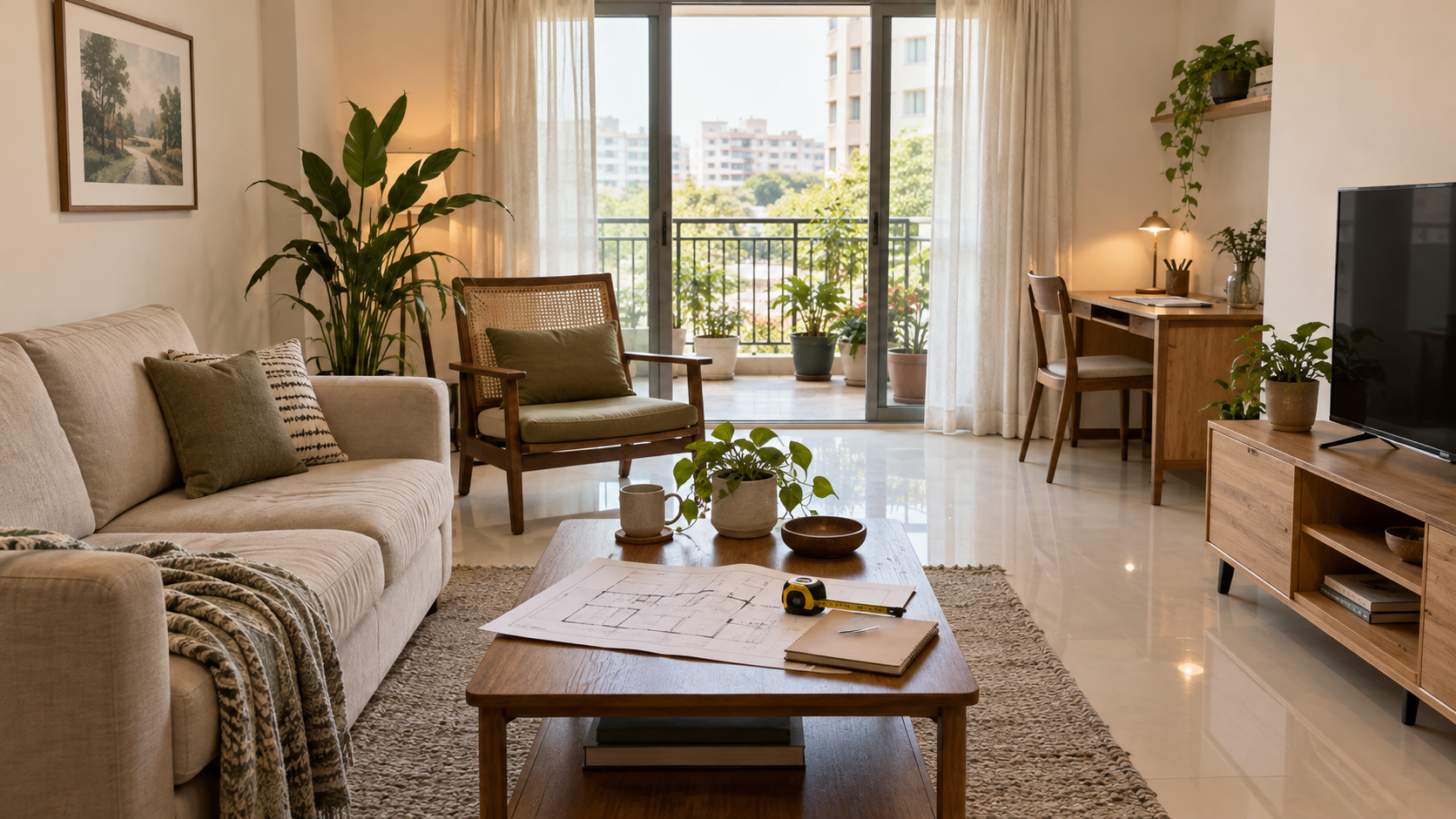
How Do You Plan Affordable Interiors?
Start with the layout and daily requirements, price the essential work, and add decorative upgrades only after the complete budget is clear. Retain suitable existing items, compare equivalent specifications and phase purchases that can wait without causing rework.
Affordable interior design is about deciding what deserves your budget.
A modestly priced sofa becomes an expensive mistake if it blocks the room. Extra cabinetry adds little value if its storage is difficult to use. A low quotation may become unaffordable when essential exclusions are added.
The aim is to spend deliberately on a home that works for your household.
1. Define what your budget must cover
Before choosing finishes, list everything you expect to pay for. Separate the design fee from materials, fabrication, site work and purchases. Include expenses handled by different vendors in the same budget.
| Budget category | Items to consider |
|---|---|
| Planning | Design consultation, visualisation and required drawings |
| Fixed furniture | Kitchen cabinets, wardrobes and other built-in storage |
| Site work | Agreed electrical, plumbing, painting and other alterations |
| Loose furniture | Beds, sofa, dining furniture and movable storage |
| Appliances | Selected kitchen and household equipment |
| Furnishings | Curtains, mattresses, rugs and other essentials |
| Additional charges | Applicable taxes, delivery, installation and handling |
| Reserve | Money kept available for unresolved or unexpected requirements |
Mark which amounts are estimates and which are confirmed quotations. Review the full total before approving any individual package.
2. Sort your requirements into three groups
Decide what is essential now, what would be useful and what can wait.
| Priority | How to decide | Examples to assess |
|---|---|---|
| Needed before moving in | Supports an essential daily activity | Sleeping arrangements, required kitchen facilities, privacy and basic storage |
| Useful if affordable | Improves comfort or convenience | Additional drawers, a dedicated study or extra storage |
| Can be added later | Can wait without disrupting essential use | Artwork, occasional furniture and selected decorative treatments |
These categories depend on your household. A study desk may be essential for someone working from home. A guest-room bed may be less urgent if the room will rarely be used.
Agree on these priorities before reviewing upgrades.
3. Spend first on getting the layout right
Furniture dimensions and placement affect how comfortably you use the home.
Before purchasing, check:
- Door and drawer movement.
- Access around beds.
- Dining chairs in use.
- Wardrobe openings.
- Appliance dimensions.
- Routes between rooms.
- Access for cleaning and maintenance.
Use the actual dimensions of products you are considering. If an arrangement is awkward, revise the layout or furniture selection before trying to solve it with smaller accessories.
4. Protect essential work and everyday function
Avoid reducing costs without understanding what the proposed change affects. Ask the designer or execution team to explain the implications of changes to materials, hardware, installation and necessary site work.
Pay particular attention to:
- Furniture that will be used frequently.
- Storage designed for heavy or specific items.
- Areas around plumbing.
- Hardware carrying moving shutters and drawers.
- Electrical and plumbing requirements.
- Fixing and installation arrangements.
The goal is to select suitable specifications for the application. Ask for the reasoning behind a recommendation and an itemised price for alternatives.
5. Save by simplifying the scope
Reducing the amount or complexity of work can be easier to evaluate than accepting an unspecified material downgrade.
| Proposed expense | A simpler option to investigate |
|---|---|
| Extensive TV wall treatment | A cabinet sized for the equipment and storage actually needed |
| Decorative panelling across several rooms | A limited feature area or suitable wall finish |
| Custom furniture in every room | Ready-made pieces where dimensions and function work |
| Many specialised storage accessories | Shelves or drawers where they meet the same need |
| Full-room ceiling treatments | A ceiling and lighting arrangement based on actual requirements |
| Separate furniture for every activity | A shared piece where both functions remain comfortable |
Ask the vendor to price the revised scope explicitly. Do not assume a simpler appearance automatically means a lower quotation. Confirm the saving before approving the change.
6. Retain existing furniture where it fits the plan
List the items you already own before starting the design. Measure them and assess their condition, usefulness and compatibility with the proposed layout.
For each item, decide whether to:
- Keep it as it is.
- Move it to another room.
- Refurbish or reupholster it.
- Replace it.
Obtain a price for refurbishment before choosing that route. Consider transport, repairs and the likely result alongside the cost of a replacement.
An existing item is worth retaining when it serves the home well, rather than simply because you already have it.
7. Compare specifications before negotiating totals
A discount is difficult to assess if the scope remains vague.
Ask each vendor to quote against the same dimensions, materials, hardware and quantities. Confirm delivery, installation, taxes and exclusions.
If a quotation exceeds your budget, request specific alternatives:
- What changes if we remove this unit?
- What is the saving from this finish change?
- Which accessories are optional?
- Can we retain this existing element?
- How does a ready-made alternative affect the layout?
Keep a record of what is removed or changed. Check that the revised quotation still covers the work you expect.
8. Phase the purchases that can wait
You do not have to buy every decorative item before moving in. Some movable furniture, artwork and accessories can be selected after you have lived in the space and understood your habits.
Fixed work requires more careful sequencing. Before postponing something, ask:
- Will later installation disturb finished surfaces?
- Are wiring or other provisions needed now?
- Will access become more difficult?
- Will matching materials need to be sourced later?
- Can the room function comfortably without it?
Agree on the sequence with the execution team. Record deferred items so they remain outside the current order.
9. Keep track of small upgrades
Budget growth often happens through a series of decisions that look manageable individually. A finish change, extra drawer, larger unit and additional light can collectively affect the whole-home total.
Maintain a simple change log:
| Record | What to enter |
|---|---|
| Proposed change | The item and room affected |
| Reason | The problem it solves or preference it supports |
| Price difference | Additional charge or credit |
| Other effects | Delivery, installation or related work |
| Decision | Approved, rejected or deferred |
| Revised total | Updated committed spending |
Review the revised total before approving another change.
10. Choose décor after the main pieces are settled
Once the layout and essential furniture are confirmed, select curtains, rugs, lighting and decorative items in relation to them. Check dimensions, colours and maintenance requirements before ordering.
Avoid buying several small pieces simply to fill empty areas. Leave room to understand what the home needs in use.
A considered room does not require every surface to be decorated.
Where should you spend and where can you save?
Use the following questions to guide each decision.
| Decision | Give it priority when… | Consider simplifying when… |
|---|---|---|
| Storage | It accommodates belongings you use and need to access | It duplicates storage or has no defined purpose |
| Hardware | It supports frequent use or a specific operating requirement | An accessory adds complexity without a clear benefit |
| Furniture | Its dimensions and comfort suit daily use | Bulk or decorative details compromise the room |
| Finishes | They suit the application and maintenance expectations | The upgrade is mainly visual and exceeds your priorities |
| Lighting | It supports a required activity | Additional decorative fixtures have no clear role |
| Custom work | Standard products do not meet the dimensions or function | A suitable ready-made option fits the brief |
Treat this as a decision framework, not a rule that applies identically to every home.
Common budget mistakes to avoid
- Buying before measuring: Check the complete furniture footprint and its operating space.
- Ignoring excluded purchases: Keep appliances, mattresses and furnishings in the overall budget.
- Changing decisions after fabrication begins: Understand the charge and delivery implications before approving revisions.
- Using vague specifications: Record the agreed products, materials and hardware.
- Spending the reserve on upgrades too early: Keep unresolved requirements visible until their costs are clearer.
- Overfurnishing occasional-use rooms: Allocate spending according to how often and how intensively each room is used.
Frequently asked questions
Is custom furniture always more expensive than ready-made furniture? No. Compare suitable products with similar dimensions, materials and functionality. Include delivery, assembly and any modifications needed.
Can I furnish my home one room at a time? Yes. Plan the home as a whole first, then coordinate any shared or disruptive work before phasing individual purchases.
Should I skip professional design to save money? That depends on the decisions you need help making. Compare the design fee and deliverables with your project requirements. A limited consultation or room-specific service may suit some projects.
Are decorative wall treatments essential? Only if they are a priority within your design and budget. Price them separately so you can decide after essential work is covered.
How much should I keep as a reserve? Set it according to the uncertainties in your project, including site conditions and undecided scope. Discuss the allowance with your team rather than treating one percentage as suitable for every home.
What is the first step when my quotation exceeds the budget? Check the full scope and exclusions, then rank items by importance. Request priced revisions for specific changes instead of asking only for a lower total.
Build a plan around what matters to your household
At Houspire, we help homeowners clarify layouts, storage needs and design preferences before committing to execution.
Share your spending limit, existing furniture and everyday priorities. Use the planning stage to decide what belongs in the home now and what can be added later.
[Explore Houspire's design plans →]