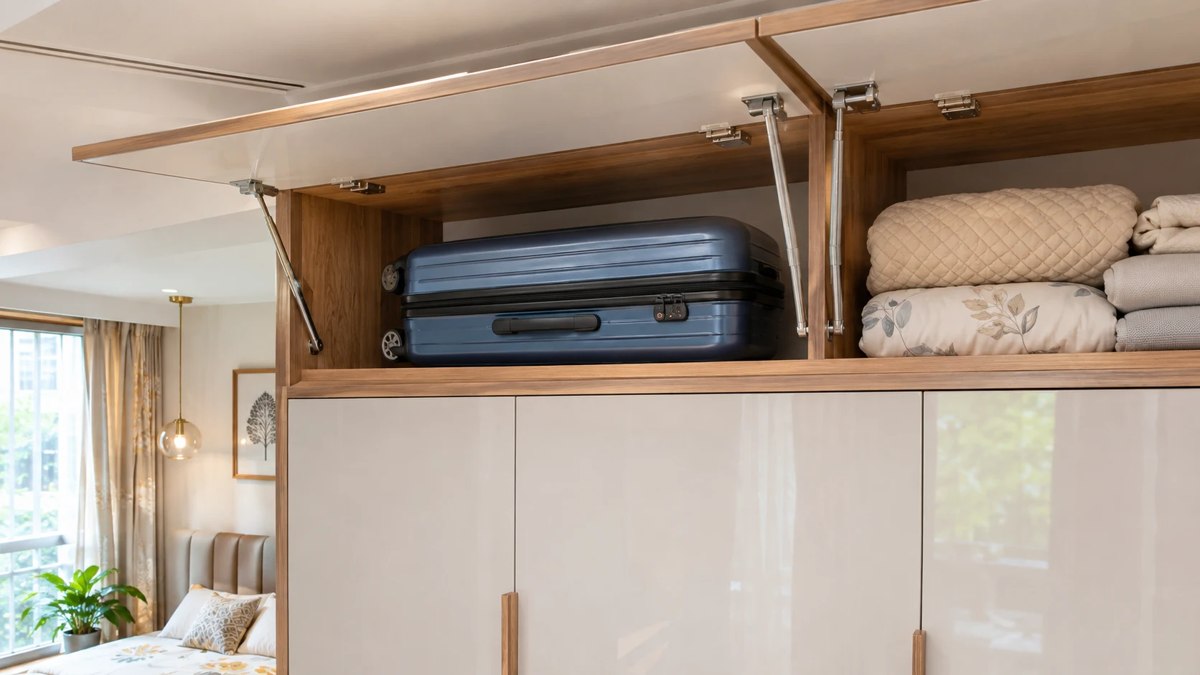
Wardrobe loft size should follow the suitcase or bedding you intend to store. An item can fit inside a cabinet yet fail to pass through its opening.
Check the complete entry path, usable depth and retrieval space before approving the loft.
What loft size do you need for a suitcase?
Take an illustrative suitcase measuring 76 cm long × 50 cm wide × 30 cm thick, including its wheels and handles. Suppose you want to lay it flat and slide it straight in with the long side facing you. In that position, the case occupies 76 cm across the opening, 50 cm into the wardrobe and 30 cm in height.
Now compare two possible loft designs. The example measurements below are taken after allowing for the finished panels and with the shutter open.
| Measurement | What the suitcase needs | Loft A | Loft B |
|---|---|---|---|
| Clear width of one compartment opening | 76 cm | 82 cm | 82 cm |
| Clear height at the opening | 30 cm | 28 cm | 35 cm |
| Usable depth with the shutter closed | 50 cm | 55 cm | 55 cm |
| Internal height above the shelf | 30 cm | 38 cm | 38 cm |
| Does it slide straight in? | No. The opening is 2 cm too low. | Yes. The opening leaves 5 cm above the case. |
Both lofts have the same internal height and depth. In Loft A, a frame or shutter detail reduces the entrance to 28 cm. Loft B gives the case a clear path. Its spare 5 cm is specific to this example. Try the movement with your own case to see whether you have enough room to grip and guide it.
What if you turn the suitcase sideways? That brings the 50 cm side across the opening, but sends the 76 cm side into the cabinet. With only 55 cm of usable depth, the shutter cannot close. Always check width, height and depth in the same orientation.
What should you measure on your own wardrobe plan?
| Check | How to measure it |
|---|---|
| The packed item | Measure the suitcase across its furthest projections, including wheels, feet and fixed handles. For bedding, measure the filled storage bag or box. |
| One usable opening | Measure one compartment between its side panels or central divider. A 6-foot wardrobe can have several narrower loft openings. Opening two shutters only helps if the space between them is clear. |
| The narrowest point on the way in | Ask the carpenter to mark the clear height above the shelf’s front edge with the shutter fully open. Include any frame, lip, hinge or lift mechanism that projects into the path. |
| Depth behind a closed shutter | Measure from the inside of the closed shutter to the back panel. Check that the wheels and handle sit fully inside that space. |
| Where you will stand | Mark the bed, bedside table and curtain position below the loft. Check whether you have a stable place to stand and enough room to bring the item down. |
For a lift-up shutter, ask to see its highest point when fully open against the finished ceiling, including any false-ceiling drop. For a side-hinged shutter near a window, check its swing against the curtain track and gathered curtains. A front elevation shows how the closed loft looks. An open-shutter view shows whether you can use it.
Is a full-width loft worth it?
Start with the number of items that need independent access. If two smaller suitcases travel inside one large case, measure the outer case once. If family members use their suitcases separately, test whether either case can come down while the other stays on the shelf.
| What you plan to store | What to prioritise |
|---|---|
| One nested suitcase set | One compartment wide enough for the largest case, with an accessible grip when you pull it forward. |
| Spare quilts and blankets | Shelf openings sized around filled bags. Two smaller bags may be easier to retrieve separately than one tightly packed bundle. |
| Frequently used travel bags | A shelf you can reach conveniently, particularly if you travel every month. |
| Heavy or awkward items | Lower storage where you can lift the item close to your body. Ask the maker to confirm the shelf’s load capacity for the intended contents. |
If one compartment takes all your seasonal items, ask for a partial loft as a second design option. It may let you retain taller hanging space in the adjoining bay. If the suitcase fits on paper but you cannot comfortably bring it down beside the bed, a lower cupboard may earn its space more readily.
Frequently asked questions
Is a 2-foot-deep wardrobe loft enough for a large suitcase?
It can be. Two feet is about 61 cm, but the quoted figure may be the wardrobe’s external depth. In the worked example, the case needs 50 cm of clear depth in its chosen position. Ask for the usable measurement behind the closed shutter, then check the opening width and height separately.
Can a loft share the same shutter divisions as the wardrobe below?
Yes, if those divisions suit what you store. Before aligning every loft shutter with the wardrobe below, mark the largest suitcase across the elevation. If a fixed divider cuts across its entry path, ask the designer to revise the loft compartments while keeping the lower wardrobe layout you prefer.
What should I ask my carpenter before approving a wardrobe loft?
Send the suitcase dimensions and this request: Please mark the clear opening width and height of each loft compartment, the usable shelf depth and the shutter in its fully open position. My largest suitcase measures ___ × ___ × ___ including wheels and handles. Please show which way it will slide in and where I will stand to take it down.
Plan your next steps with Houspire
Use Houspire to explore design support for your room before committing to purchases. Confirm the selected package’s views, drawings, revisions and exclusions; have your execution team verify site measurements and construction details.
For related guidance, read choosing wardrobe storage for your clothes and sliding versus hinged wardrobes.