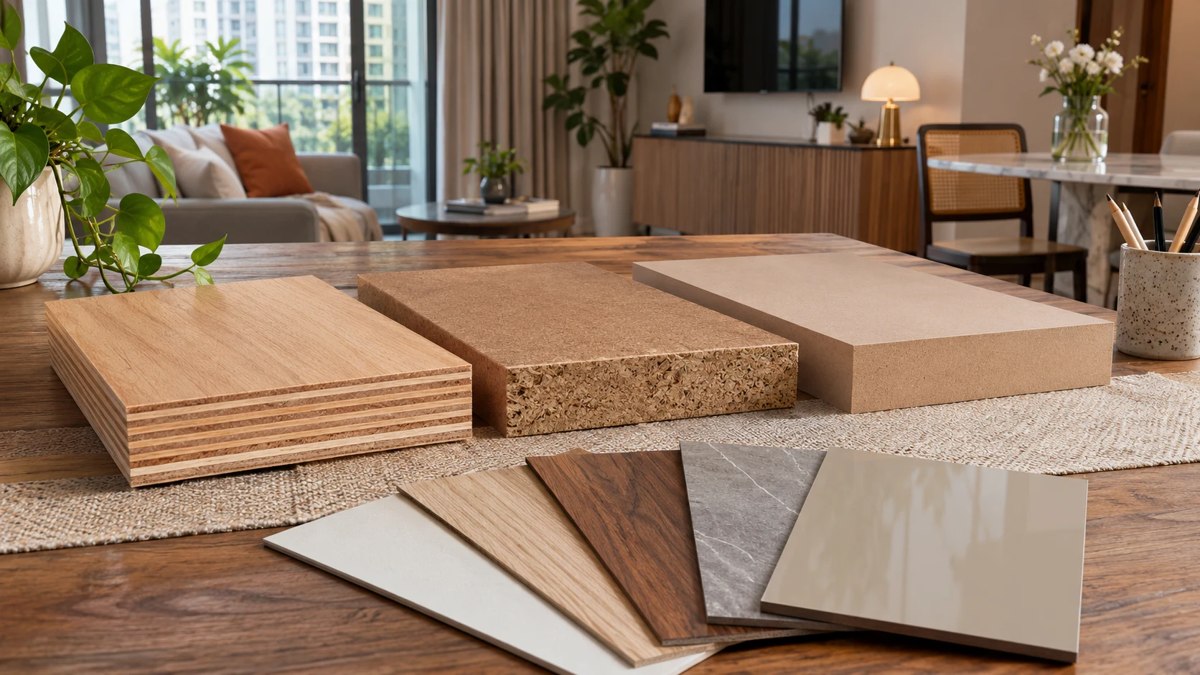
Choose plywood, HDHMR or MDF for a specific furniture component rather than treating one board as the best answer for the whole home. Compare the named product, grade, thickness, finish and construction requirements.
A cabinet body, shutter and back panel perform different jobs and may need different specifications.
What Is the Difference Between Plywood, HDHMR and MDF?
Plywood is made from bonded wood veneers, usually arranged with alternating grain directions. MDF is made from wood fibres bonded and pressed into boards. HDHMR refers to high-density, high-moisture-resistant fibreboard products.
Each category contains products with different specifications. “Plywood” does not identify a moisture-resistance grade, and “MDF” does not tell you whether the board is intended for dry or moisture-prone conditions.
A material category is not a complete furniture specification.
Plywood: What Should You Check?
Plywood can be considered for cabinet bodies, shelves, shutters and other furniture components. Its suitability depends on the selected product and how the furniture is built.
Ask the carpenter to identify:
- Manufacturer and product name.
- Grade and applicable certification.
- Thickness of each component.
- Face quality required for the proposed finish.
- Joinery and fixing arrangements.
- Treatment of exposed edges and cut-outs.
MR, BWR and BWP Are Different Descriptions
MR means moisture resistant, BWR means boiling water resistant and BWP means boiling water proof.
These descriptions concern material performance; they do not make a completed cabinet immune to leaks, installation defects or unsuitable detailing.
Avoid approving a quotation that says only “waterproof plywood.” Ask for the exact product, grade and manufacturer documentation.
Do Not Assume Every Component Is Plywood
A supplier may describe a wardrobe as plywood while using another board for its shutters or back panel.
That combination may be intentional and suitable. It should be recorded clearly so you know what you are buying.
HDHMR: Where Does It Fit?
HDHMR is a fibreboard option worth evaluating when the design requires moisture resistance, a smooth surface or routed details.
Ask the fabricator:
- Is the proposed product suitable for this specific component?
- Does the selected thickness suit the shutter or shelf dimensions?
- What finishing and edge treatment are required?
- Are the hinges and other fittings appropriate for the finished panel?
- What installation and warranty conditions apply?
A claim such as “HDHMR is stronger than plywood” is too broad to resolve your purchase. Ask which property is being compared, between which products and for what application.
Moisture Resistance Does Not Replace Site Repairs
If a wall is damp or plumbing is leaking, resolve the cause before installing cabinetry.
Do not treat a board upgrade as a substitute for correcting the site condition. The finished unit includes joints, edges, fittings and surfaces whose performance also matters.
MDF: When Can It Be a Practical Choice?
MDF is worth discussing for furniture and decorative components that need a smooth finished surface or shaped details.
The key distinction is the exact grade. Standard interior MDF and moisture-resistant MDF should not be treated as interchangeable.
For an MDF proposal, confirm:
- The named product and grade.
- Whether it suits the room conditions.
- How faces and edges will be finished.
- The construction of shelves and joints.
- The fixing method for hinges, handles and wall-mounted parts.
Do not accept “MDF is always bad” or “MDF works everywhere” as a useful specification.
Which Material Is Better for Wardrobes?
Plan the wardrobe component by component.
| Wardrobe component | What should guide the selection |
|---|---|
| Cabinet body | Dimensions, joints, expected loads and room conditions |
| Shelves | Span, contents, thickness and support |
| Shutters | Size, finish, weight and hardware requirements |
| Drawer boxes | Construction, contents and runner compatibility |
| Back panel | Material, thickness and fixing detail |
| Loft | Access, stored items and support arrangement |
A plywood cabinet body with a different shutter material may be appropriate for a particular design. A consistently specified fibreboard system may also be appropriate.
Ask the supplier to explain the complete construction rather than choosing from the exterior appearance alone.
If the wardrobe sits beside a bathroom or against a wall with a history of dampness, include that information in the brief.
Which Material Is Better for Kitchen Cabinets?
A kitchen contains different exposure conditions. A wall cabinet storing plates is not in the same situation as a sink cabinet containing plumbing connections.
Separate the quotation into:
- Base cabinets.
- Wall cabinets.
- Sink cabinet.
- Tall units.
- Shutters.
- Shelves and drawers.
- Exposed end panels.
Ask how the material and construction address each location.
Check edge treatment, plumbing cut-outs, access to connections and the way the unit meets the floor. Follow the requirements for nearby appliances rather than enclosing them based only on the visual design.
There is no useful kitchen-wide answer based solely on the words plywood, HDHMR or MDF. You need the product, location and construction details together.
What About Long Shelves and Heavy Shutters?
Material selection cannot compensate for an unsuitable furniture design.
A long shelf needs a thickness and support arrangement appropriate to its span and intended contents. A tall shutter needs suitable construction and fittings.
Ask the fabricator to verify:
- Unsupported shelf lengths.
- Expected storage loads.
- Panel thickness.
- Joint and fixing details.
- Shutter dimensions and weight.
- Hinge or runner suitability.
Avoid approving the same shelf construction for folded clothes, books and heavy kitchen items without reviewing the intended use.
Which Material Is Cheapest?
Compare current quotations for the exact products and thicknesses under consideration.
A universal price ranking is unreliable because the finished cost also includes:
- Laminates, paint or other finishes.
- Surface preparation.
- Edge finishing.
- Machining and routing.
- Hardware.
- Fabrication.
- Delivery and installation.
A lower-priced board may not produce the lowest finished quotation once the required work is included.
Use a comparison like this:
| Cost component | Option A | Option B |
|---|---|---|
| Board | Named product and thickness | Named product and thickness |
| Finish | Same specified finish | Same specified finish |
| Hardware | Suitable specified models | Suitable specified models |
| Fabrication | Defined scope | Defined scope |
| Installation | Defined scope | Defined scope |
| Total | Complete quoted amount | Complete quoted amount |
Ask vendors to explain any necessary differences in construction rather than forcing an unsuitable one-for-one substitution.
What Should Your Carpenter’s Quote Say?
Replace vague descriptions with a component schedule.
For example: Wardrobe carcass: Manufacturer, product, grade and thickness. Shutters: Manufacturer, substrate, thickness and approved finish. Back panel: Material, thickness and fixing method. Shelves: Thickness, dimensions and support details. Hardware: Brand, model and quantities. Edges and cut-outs: Agreed finishing treatment. Substitutions: Written approval required before purchase or fabrication.
This makes alternatives easier to compare and deliveries easier to check.
Keep photographs of product labels and purchase records where available. When a supplier proposes a substitution, record the exact replacement, reason and cost adjustment.
Common Mistakes to Avoid
Choosing From the Laminate Sample Alone
Laminate shows the visible finish. It does not establish the board underneath.
Assuming One Brand Name Specifies the Whole Unit
Manufacturers sell multiple products and grades. Record the product name as well as the brand.
Treating a Moisture Claim as Protection Against Every Leak
Read the product’s intended-use guidance and warranty conditions. Address dampness and plumbing problems separately.
Using the Same Construction for Every Component
Different spans, loads, finishes and fittings can require different specifications.
Approving a Cheaper Substitute Without Reviewing the Details
Compare the product, construction implications, finish and final price before accepting the change.
Plan the Furniture Before Finalising the Board
Start with the layout, dimensions, storage requirements and desired finish. Then ask the designer and fabricator to specify suitable materials for each component.
Frequently asked questions
Is HDHMR better than plywood?
Neither is universally better. Compare specific products for the intended component, moisture exposure, finish, dimensions and fixing requirements.
Is MDF suitable for wardrobes?
It can be suitable for specified wardrobe components when the grade, construction and room conditions are appropriate. Confirm the exact product rather than approving generic MDF.
Is HDHMR waterproof?
HDHMR describes high moisture resistance. Check the selected product’s test data, intended applications and warranty rather than assuming unlimited resistance to water.
Can I use different materials in the same wardrobe?
Yes. Cabinet bodies, shutters and back panels can use different materials. Record each component and confirm that the overall construction is suitable.
Should every kitchen cabinet use the same board?
Not necessarily. Different locations and components can have different requirements. Ask for a specification that addresses each area, particularly around plumbing and appliances.
What matters most when comparing material quotations?
Compare the manufacturer, product, grade, thickness, finish, hardware and construction details. Then compare the complete installed price.
Plan your next steps with Houspire
Use Houspire to explore design support for your room before committing to purchases. Confirm the selected package’s views, drawings, revisions and exclusions; have your execution team verify site measurements and construction details.
For related guidance, read what a BOQ should contain and working with your own carpenter.