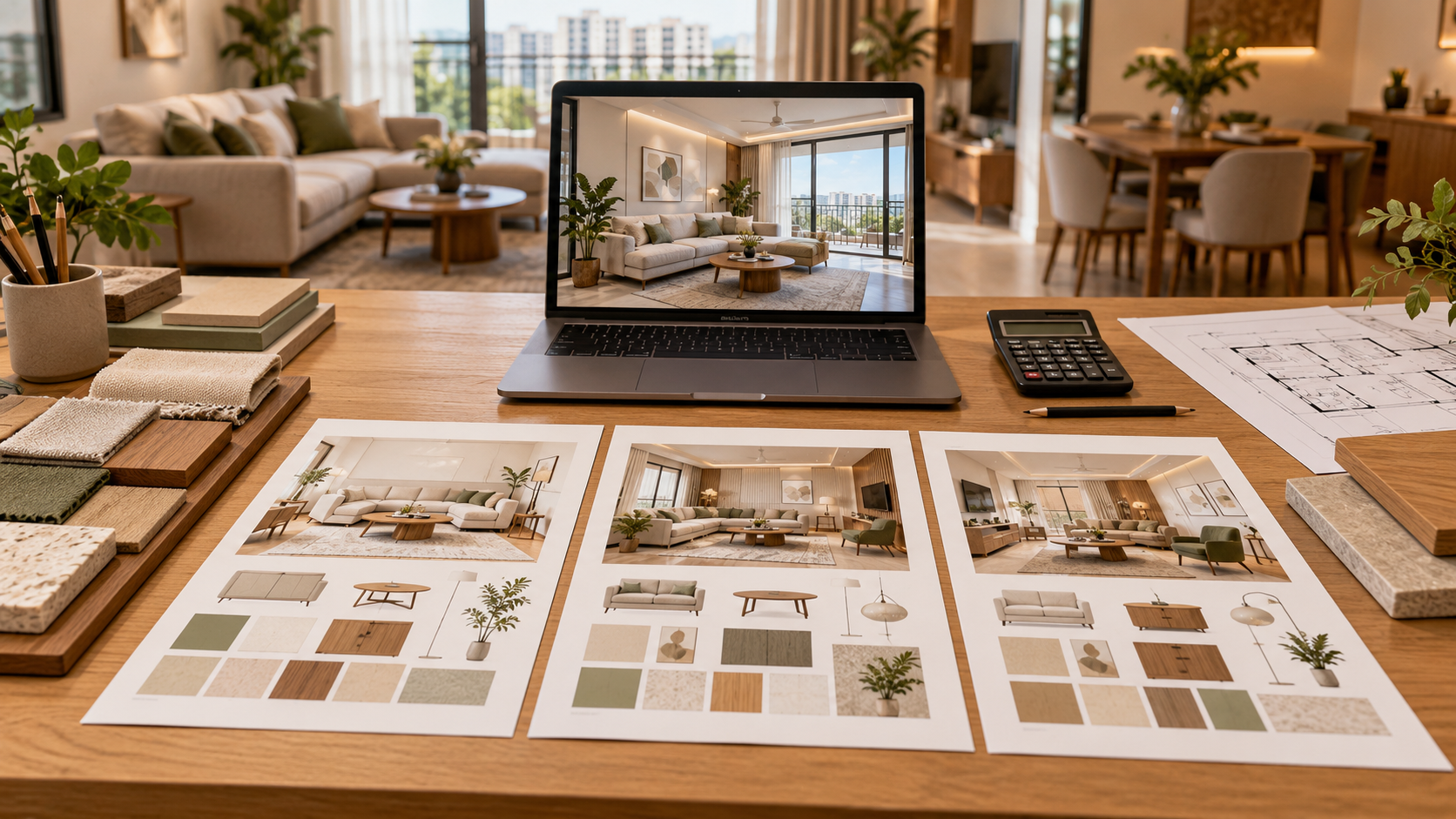
Flat-Fee Interior Design: Understand Your Plan and Complete Project Cost
A fixed design fee is easier to evaluate when you know exactly what it covers.
Compare the documents, room coverage and support before judging the price.
Keep the design-service bill separate from the cost of furnishing and completing your home.
What Is Flat-Fee Interior Design?
Flat-fee interior design is a pricing arrangement in which a designer charges an agreed amount for a defined scope of services.
The fee might cover one room, selected spaces or an entire home. It can also apply to a specific task, such as preparing a furniture layout or developing a room concept.
The agreed scope should identify:
Which spaces are included.
What documents or images you receive.
How many options and revisions are provided.
What information you must supply.
Which consultations or follow-up services are included.
What circumstances can lead to additional charges. A flat fee makes the price of the agreed service clear. Changes beyond that scope may require a separate quotation.
How Does Flat-Fee Pricing Compare with Other Models?
Interior design services can use several pricing methods. The pricing method alone does not tell you how comprehensive the service will be.
| Pricing model | How the charge is calculated | What to clarify |
|---|---|---|
| Flat fee | An agreed amount for defined services | Scope, deliverables and extra-work charges |
| Hourly fee | Time spent multiplied by an hourly rate | Estimated hours, reporting and approval limits |
| Per-square-foot fee | An agreed rate multiplied by a defined area | Area basis and services covered |
| Percentage fee | A percentage of a defined project cost | Which expenses form the calculation base |
| Combined model | Different methods for different services | How each component is calculated |
For example, a designer could charge a fixed fee for the initial plan and an hourly fee for additional consultations.
Ask for the complete pricing arrangement in writing.
What Can a Flat-Fee Interior Design Plan Include?
Package contents vary. Treat the following as possible deliverables to check, rather than a standard list included in every plan.
Design Brief and Consultation
The designer gathers information about your home, preferences, budget and daily routines.
Clarify whether this happens through a questionnaire, a scheduled call, a site visit or a combination. Also check whether you can discuss questions after receiving the first proposal.
Furniture Layout
A furniture layout shows where proposed items sit within the room.
Check whether it includes dimensions and furniture sizes, and whether it incorporates pieces you already own. A decorative concept board does not provide the same information as a measured layout.
Mood Board and Material Direction
A mood board communicates the proposed colours, finishes, furniture styles and overall atmosphere.
Ask whether the selections are general references or specific products. This affects how easily you can turn the proposal into purchases.
3D Room Views
Visualizations help you assess the proposed appearance.
Confirm the number of views, the areas shown and whether alternative designs count as additional work. One image from one angle may leave parts of the room unseen.
Product List or Budget Guidance
Some plans include shopping suggestions, indicative costs or an itemized budget.
Clarify whether the figures represent allowances, listed product prices or vendor quotations. Ask how delivery, installation, labour and taxes are treated.
Working Drawings
Working drawings can provide dimensions and details for specified execution tasks.
Confirm exactly which drawings are included. A furniture layout, a wardrobe elevation and a detailed electrical layout serve different purposes.
Do not assume a package includes contractor drawings simply because it includes realistic room images.
What Is Commonly Outside the Design Fee?
Check these items explicitly when comparing plans:
| Possible additional cost | What to ask |
|---|---|
| Furniture and furnishings | Are purchases separate from the design service? |
| Materials and hardware | Does the quoted fee include any physical products? |
| Labour and installation | Who prices and manages execution? |
| Site measurements or visits | Are these included, optional or unavailable? |
| Additional views or rooms | How are they priced? |
| Extra revisions | What counts as a revision or a new brief? |
| Technical drawings | Which drawings require an add-on? |
| Procurement and supervision | Who handles orders, deliveries and site coordination? |
| Taxes | Is the displayed price inclusive or exclusive? |
An exclusion is manageable when it is disclosed early. It becomes a budgeting problem when you discover it after relying on the package to cover that need.
How Do You Calculate the Complete Client Cost?
Separate your design-service bill from the cost of completing the home.
A useful planning structure is:
Design fee + approved design add-ons + furniture and materials + execution and logistics + applicable taxes + contingency reserve
Check for overlap before adding figures. For example, an installed cabinetry quotation may already include materials and labour.
An Illustrative Budg**The figures below are hypothetical. They demonstrate the calculation and do not represent market rates or a Houspire package.**age.
| Budget component | Illustrative amount |
|---|---|
| Fixed design fee | ₹10,000 |
| Additional agreed drawings | ₹4,000 |
| Furniture and furnishings | ₹90,000 |
| Painting and electrical work | ₹25,000 |
| Delivery and assembly | ₹6,000 |
| Subtotal before any applicable taxes | ₹1,35,000 |
| Separate contingency reserve | ₹10,000 |
| Planned allocation before any applicable taxes | ₹1,45,000 |
The design fee is ₹10,000, while the planned allocation is substantially larger. The reserve remains money set aside until needed and approved.
How Do Revisions Work in a Flat-Fee Plan?
Revision terms deserve as much attention as the initial deliverables.
Ask whether a revision means changing colours and finishes within an approved concept or requesting an entirely different layout.
For example, replacing a proposed curtain colour may fall within a revision round. Changing a guest bedroom into a home office could alter the brief substantially.
Confirm:
The number of included revision rounds.
Whether feedback must be consolidated.
The deadline for requesting changes.
Which changes are outside the original scope.
How additional work is approved and charged. Provide clear feedback tied to your requirements. “Please retain our existing bed and add closed document storage” is more actionable than “make it better.”
When Does Flat-Fee Interior Design Make Sense?
A fixed-fee arrangement can suit a project when the required services are clearly defined.
You might want to plan one room before buying furniture, coordinate finishes across an apartment or obtain specified design documents before engaging a contractor.
The key is matching the package to your next decision.
If you need someone to measure the property, coordinate vendors and inspect installation, look for those services explicitly. A remote design package may cover only part of that process.
For a renovation with unresolved site conditions, ask how new information will affect the design scope and fee.
How Should You Compare Flat-Fee Interior Design Plans?
Compare deliverables side by side before judging value.
| Comparison point | Question to ask |
|---|---|
| Room coverage | Does the plan cover every required space or zone? |
| Layout detail | Will I receive dimensions and furniture placement? |
| Visualization | How many views and design options are included? |
| Cost guidance | What does the budget information cover? |
| Execution documents | What can my contractor use directly? |
| Revisions | How much refinement is included? |
| Support | Can I ask questions after delivery? |
| Additional charges | What could increase the design-service bill? |
Request a sample deliverable where available. Seeing the format and level of detail can be more useful than relying on labels such as “premium” or “complete.”
Also check when the delivery period begins and what happens if measurements or other inputs are missing.
Planning Your Houspire Brief
Before selecting a Houspire plan, list the rooms you want to address, the furniture you intend to retain and the decisions you need help making.
Keep your design-service budget separate from the amount available for execution.
Review the selected plan’s current deliverables, views, revision terms and any drawing add-ons. If you intend to work with your own contractor, establish which measurements and documents will be needed before fabrication.
This makes it easier to choose a service that supports your next stage of work.
Final Thoughts
A flat-fee interior design plan is easier to evaluate when its scope is specific.
Check what you receive, what remains outside the fee and how changes are priced. Then build your complete home budget around the design service, purchases and execution requirements.
Explore Houspire’s design plans and read design-only versus turnkey responsibilities before selecting your service.
Frequently Asked Questions
What does a flat-fee interior designer charge for?
The agreed design services listed in the proposal. These may include consultations, layouts, visualizations, selections or specified drawings, depending on the package.
Does a flat fee include furniture and renovation work?
Only if the agreement expressly includes them. Check whether the price covers design services, physical products, execution or a combination.
Can a flat-fee design bill increase?
Yes, if you approve work beyond the agreed scope. Additional rooms, extra revisions or new deliverables may carry separate charges.
Is flat-fee interior design cheaper than hourly pricing?
Neither model is automatically cheaper. Compare the total expected charge for equivalent services and the support your project needs.
Are working drawings included in every fixed-price plan?
No. Confirm the exact drawing list and whether any execution documents require a separate fee.
What should I provide before the design starts?
Share the requested floor plan or measurements, room photographs, retained furniture details, priorities and budget. Identify any information that still needs verification.